Agents, servers & tools
Inventory the agreed workflows, MCP servers, tool manifests, identities, owners, and trust boundaries.
Know what your agents can reach, what they can change, and whether oversight holds. Leave with a practical plan to fix what matters first.
Human-led. Fixed scope, agreed before work begins.
Price, delivery window, and access confirmed in writing.
Fictional example, not a client result. Unknown evidence is marked separately. No aggregate pass/fail score.
A human-led, fixed-scope review of AI agent and MCP permissions, data access, approval gates, execution evidence, and response readiness. Receive a readiness scorecard, prioritized findings, an owner-assigned fix plan, and a reviewable evidence pack. Scope, price, timing, and access are agreed in writing before work begins.
For small and mid-size teams moving an AI agent or MCP integration toward production, or preparing for a customer security review.
A focused review can sit alongside your existing security tools and internal team.
Inventory the agreed workflows, MCP servers, tool manifests, identities, owners, and trust boundaries.
Review effective scopes, credential handling, and the gap between intended access and permitted actions.
Trace sensitive inputs, retrieval sources, tool outputs, and destinations across the workflow.
Check who may approve, what they see, and whether the exact approved action is enforced at execution.
Review useful traces, failure handling, access revocation, incident ownership, and recovery checks.
Start with the least access needed. Redacted exports and screen shares first; scoped read-only access when necessary. Tests and any changes require a separately agreed environment and authorization.
Tool manifest reviewed; the CRM identity still allows broader writes than the workflow needs.
Data sources mapped; an export path still reaches customer contact fields.
A review screen exists; approval is not bound to the exact action at execution.
Sample test traces link the proposed action, execution decision, and observed result.
The sample runbook has no named owner for revoking the agent’s access.
Fictional example, not a client result. Unknown evidence is marked separately. No aggregate pass/fail score.
0 / AbsentThe agreed control is confirmed missing.
1 / DefinedA control is documented or configured; behavior is not yet verified.
2 / VerifiedThe agreed positive and negative checks have recorded results.
3 / ExercisedThe control has also been exercised through an agreed failure or recovery scenario.
Unknown / Not assessedInsufficient evidence or outside the agreed scope. Never silently counted as a zero.
A scoped evidence review, not a certification or guarantee of audit acceptance.Agree the workflow, systems, decision, and access boundary.
Written scope + evidence requestReview configuration and run only the checks you authorize.
Evidence-linked observationsWalk through risk paths, unknowns, and what to fix first.
Scorecard + fix plan + evidence packOptionally implement agreed changes and verify the result.
Separately scoped implementationAn illustrative CRM-agent assessment with withheld identifiers. It shows the format and reasoning you can expect. It contains no client data or engagement results.
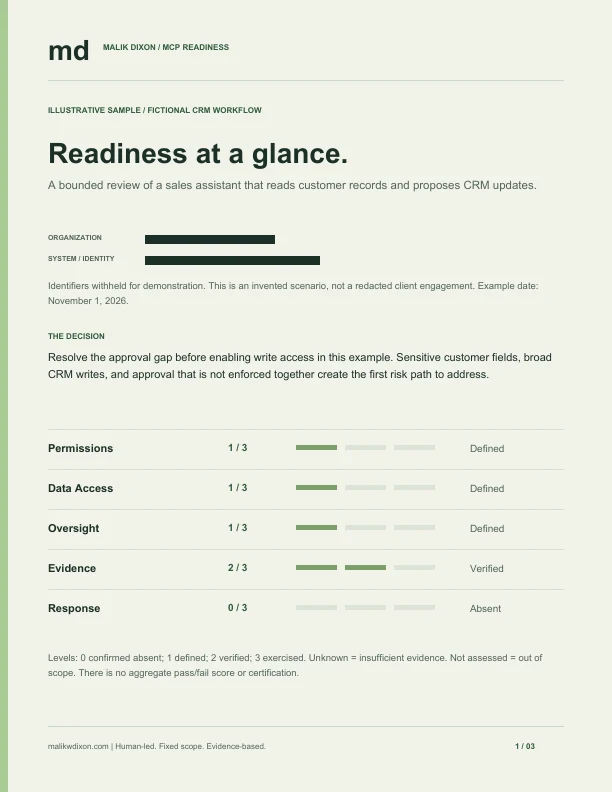 01 / Executive view
Scope, readiness levels, and the first action to take.
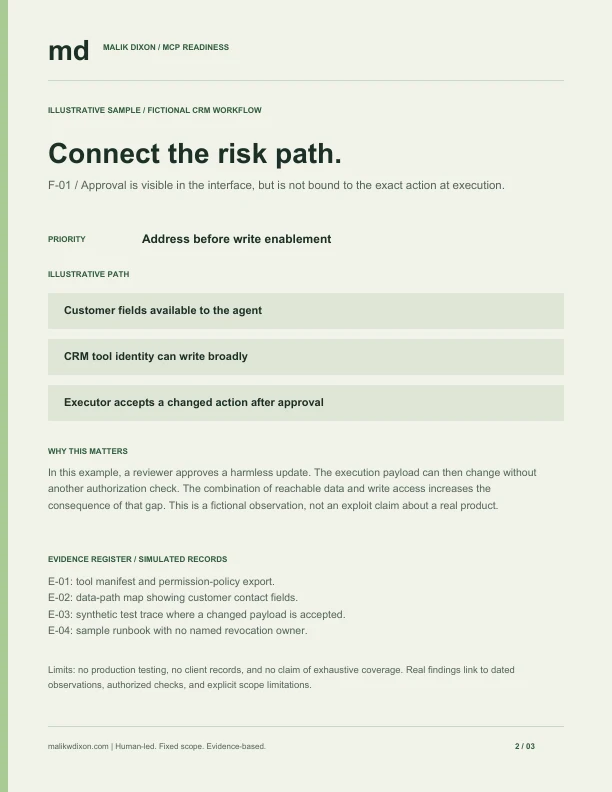 02 / Priority finding
A sensitive data source, a write-capable tool, and an unenforced approval.
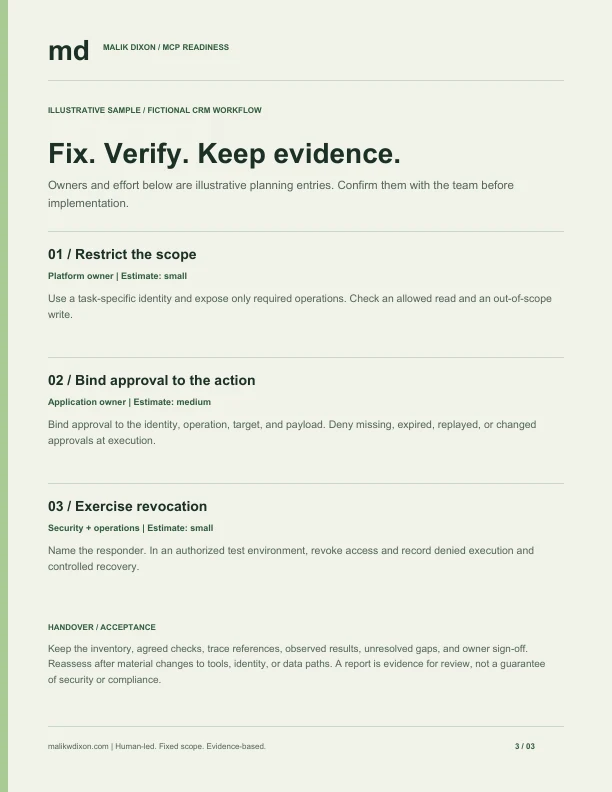 03 / Fix & verify
Named owners, estimated effort, and a concrete acceptance check.
A CNAPP supports an ongoing cloud security program. This engagement examines a named agent workflow and its controls at a point in time. Choose based on the decision you need to make.
| Your need | This assessment | A CNAPP platform |
|---|---|---|
| Primary question | What can this agent workflow do, and which controls can we verify? | What is happening across our cloud estate, and where is risk concentrated? |
| Scope & cadence | A named set of workflows, reviewed at an agreed point in time. | Continuous posture and runtime coverage across supported environments. |
| What you receive | Scorecard, prioritized fix plan, evidence, and an optional hardening phase. | Asset inventory, findings, monitoring, and response capabilities that vary by product. |
| Best fit | A launch decision, customer review, or focused check of agent boundaries. | An ongoing cloud security program with broad operational coverage. |
Possibly. Start by checking what your existing platform already covers. This assessment focuses on a bounded agent workflow: effective tool permissions, sensitive data paths, enforced approval, and execution evidence. It can complement continuous cloud monitoring. If your current team and tools already verify those controls, a separate assessment may add little.
Discovery starts with redacted architecture, tool manifests, permission policies, and representative traces. Prefer customer-provided exports, a screen share, or scoped read-only access. Any behavior testing uses an agreed test environment and explicit authorization. Production writes, credentials, and hardening are never assumed to be included.
The delivery window and price are agreed after a fit conversation, once the number of agents, servers, workflows, and test cases is clear. The fixed scope includes a five-dimension readiness scorecard, prioritized findings, a fix plan with owners and effort estimates, and an evidence pack. Missing evidence and untested areas are identified explicitly.
Hands-on hardening can be agreed as a separate phase. That may include narrowing tool permissions, binding approval to the exact proposed action, improving trace evidence, and exercising access revocation. Each change has an owner, acceptance checks, and agreed access before implementation.
No. It is an engagement-specific view of evidence across Permissions, Data Access, Oversight, Evidence, and Response. Levels run from 0 (confirmed absent) to 3 (exercised). Unknown means insufficient evidence; it is not a zero. Scores describe the agreed scope and observation date, not a guarantee of security, compliance, or audit acceptance.
Send an assessment inquiry with the workflow you are shipping, the connected tools, and the decision you need to make. Malik replies by email to discuss fit and arrange a scoping conversation. The engagement begins after both sides agree on scope, access, timing, price, and acceptance criteria in writing.
Bring the connected tools, the workflow you’re shipping, and the decision you need to make. I’ll reply by email to discuss fit and arrange a conversation.